
Anthroposophic Medicine and National Socialism
Review of a dialogue event on 3 March 2026 with Peter Selg
Peter Selg, Susanne H. Gross and Matthias Mochner have conducted research into the attitudes and positions of anthroposophic physicians during National Socialism and documented their findings in three volumes. On 3 March 2026 Peter Selg summarized their insights at a dialogue event organized by the Medical Section at the Goetheanum
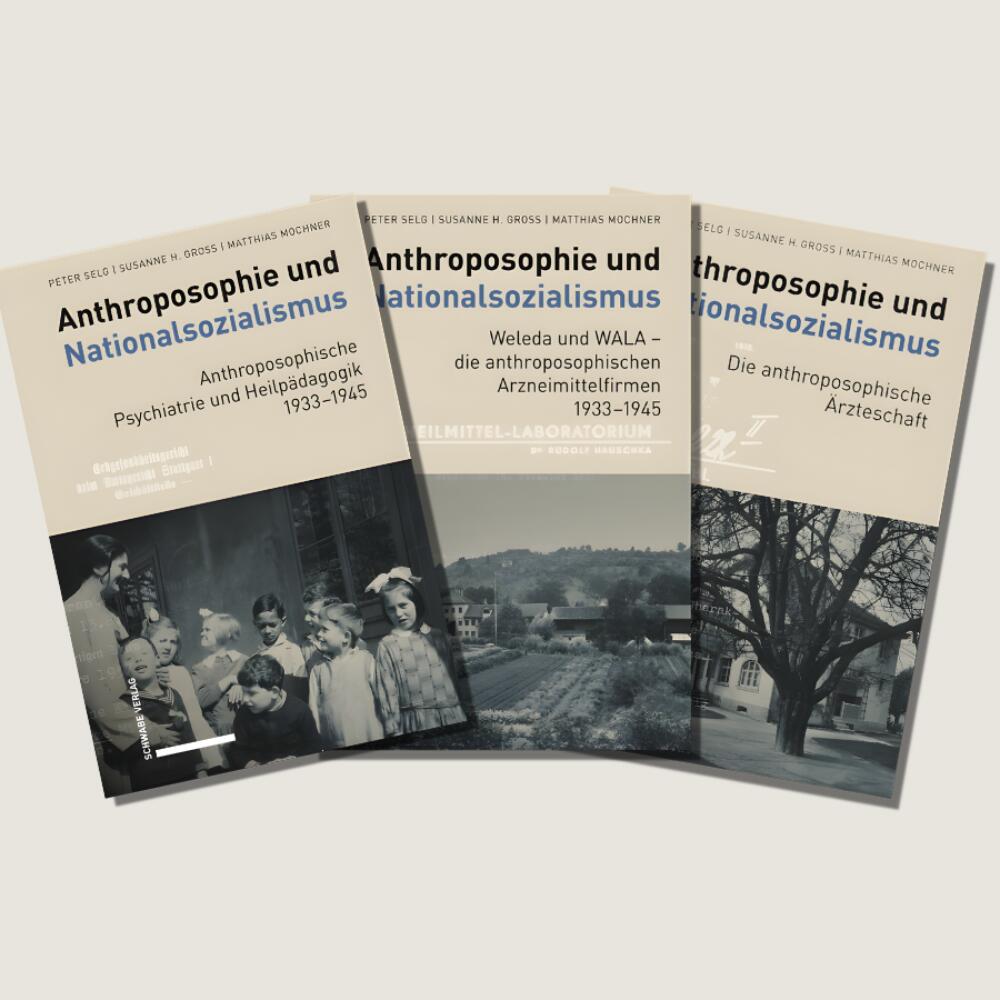
The study into Anthroposophic Medicine during National Socialism conducted by Peter Selg, Susanne H. Gross and Matthias Mochner took more than ten years. Two of the three volumes, which comprise 2500 pages in all, have been published in German by Schwabe Press under the titles Die anthroposophische Ärzteschaft [The anthroposophic physicians] and Weleda und Wala. Die anthroposophischen Arzneimittelfirmen 1933-1945 [Weleda and Wala. The anthroposophic pharmaceutical manufacturers 1933-1945] (cf. Anthroposophy Worldwide 11/2024 and 11/2025). The third volume, which will be on anthroposophic psychiatry and supportive education 1933-1945, will come out in the summer of 2026.
Peter Selg’s talk about the results of this research was attended by 150 people online and in person at the Goetheanum in Dornach (CH).
Marion Debus, who is a member of the Medical Section leadership, explained in her introduction that the study commissioned by the Academy of the Anthroposophic Medical Society in Germany and the Medical Section at the Goetheanum was not Peter Selg’s first foray into the development of Anthroposophic Medicine, pharmacy and supportive education in the Third Reich. As a lecturer at Witten/Herdecke University and Alanus University (both DE) he has organized and led study trips to the concentration camp memorial site Auschwitz-Birkenau in Poland for many years.
Elements of cooperation and resistance
Peter Selg said about the aim of the study, ‘It was our intention from the start to not only work though past events but also to make our findings available to the future.’ The study team sifted historical material such as patient files from anthroposophic hospitals and institutions for supportive education, SS archives and private letters relating to around six hundred physicians who could be considered as having been associated with anthroposophic medicine at the time. The findings reveal both cooperation with and resistance against the regime.
However, there was not as clear a definition as today of who was an anthroposophic physician because there were no comparable training guidelines or certificates. Motives for joining the Nazi Party (NSDAP) for instance cannot be judged in moral terms today because anthroposophic physicians in particular had reason to fear reprisals from the moment the Anthroposophical Society was banned by the Nazi regime.
Based on the material available Peter Selg singled out Friedrich Husemann, founder of the Husemann Klinik for psychiatry and psychotherapy in Buchenbach (DE), and Ita Wegman, the first leader of the Medical Section at the Goetheanum and head of the Anthroposophic Hospital in Arlesheim (CH), as resolute rejectors of any kind of cooperation with the regime.
Media focus on collaborators
Peter Selg regrets that even after publication of this study, the media continue to focus on collaborators, whilst hardly giving any attention to the resistance among anthroposophic physicians, pharmacists and supportive educators. While the NS regime advertised for ‘naturopaths’, which means that anthroposophic physicians are partly seen as benefitting from the regime in the public discourse, the Nazis in principle rejected the ideas of anthroposophy, a fact that is also evident from the surveillance reports of the Reich Security Service (SD). ‘There were a few individuals among the 600 or so anthroposophic physicians who viewed the Nazi regime and party favourably and even wore uniform to work, but the anthroposophic medical community distanced itself from them.
Sigmund Rascher, who conducted partly fatal low pressure and freezing experiments on concentration camp prisoners and who was later himself arrested and executed for other reasons by the Nazis, had been a Waldorf student, studied aspects of anthroposophic medicine in Dornach and worked on that basis initially. However, Peter Selg questions whether he can really be seen as an anthroposophic doctor. He for instance reported his father, an anthroposophist, to the police in Munich for visiting Dornach whilst denying his own anthroposophical background: ‘He clearly tried to burn his bridges to anthroposophy for the sake of an SS career.’
The majority acted responsibly
According to Peter Selg’s findings, the majority of anthroposophic physicians and pharmacists continued to pursue their ethical approach to medicine. While most of them did not actively stand up against the regime as anthroposophically practising physicians, they did as a small ‘exceptional group’ reject eugenics for instance. In psychiatric hospitals they avoided establishing diagnoses that could endanger their patients. Peter Selg does not rule out the possibility that attending doctors may have had advocates within the regime, as happened in the Husemann Klinik for example. Some Nazis may have been treated by anthroposophic doctors and in return protected them, as was proven in another context for the SS Gruppenführer Otto Ohlendorf.
When asked where in this field more research was required, Peter Selg said that the study had ‘explored what it had aimed to explore’ and that according to current knowledge no further material can be found on the topic. However, he sees an investigation at a higher conceptual level into anthroposophic medicine and other medical approaches as a potential field of research. In his view, this could form the basis of a new debate on principles in the sense of a ‘medical anthropology of the future’
Dialogue Can we justify interventions in the human genome? Where is medicine heading? How do we deal with the possibilities of new technologies in biology and medicine? 2 June 2026, 7 pm at the Goetheanum (free online participation)